 Soggiorna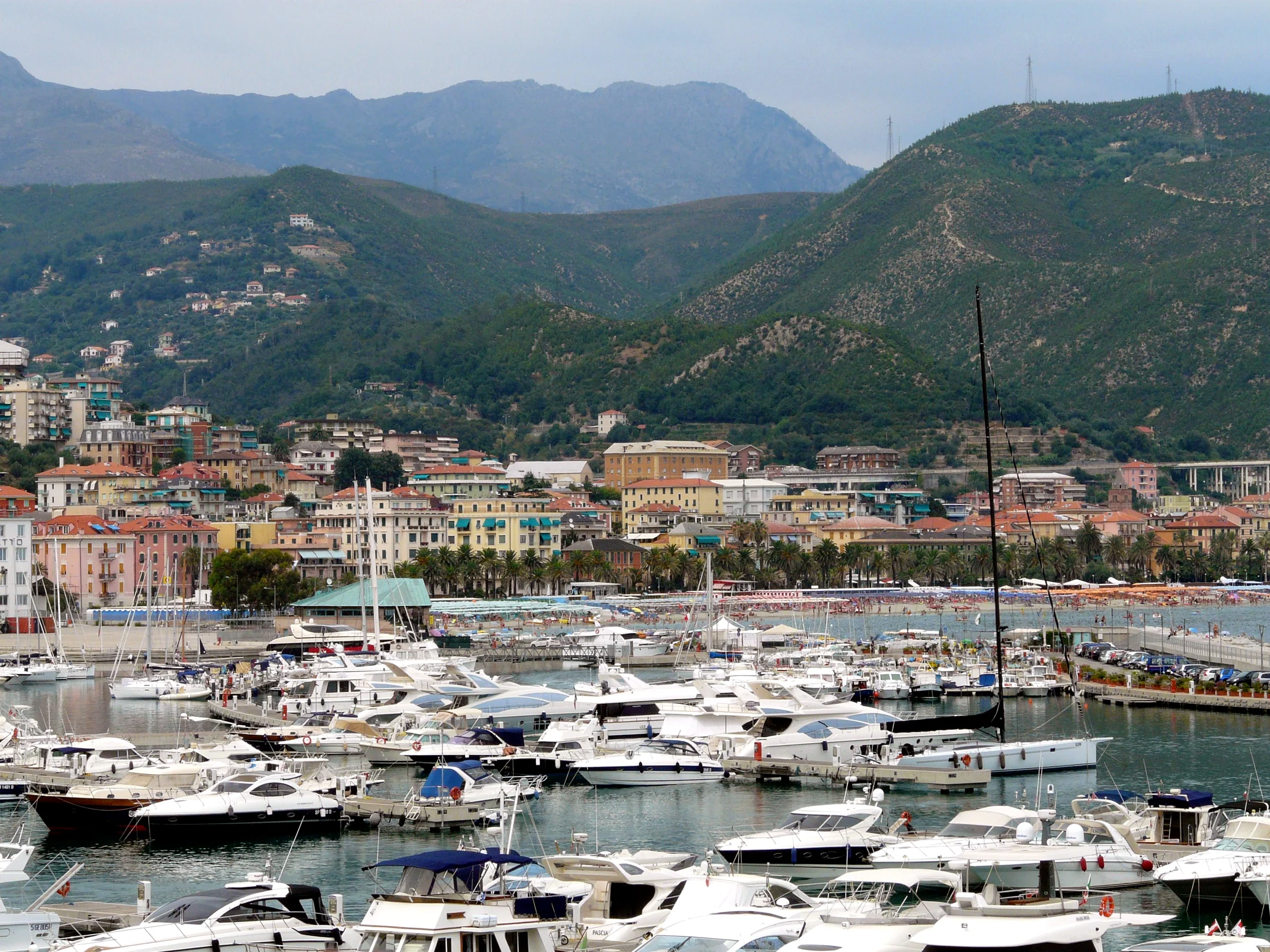
Varazze lies on the western Riviera in the province of Savona, between the Beigua mountains and the sea. It has been a seaside town for a long time: there are about forty beach clubs, and the most historic, the Kursaal Margherita baths, was dedicated to Queen Margherita of Savoy in 1887. But to understand Varazze, it is best to start with a façade.
The cannonball of San Domenico
In the façade of the church of San Domenico, which dates back to the 1400s, a cannonball fired by a French ship in December 1746 is still embedded. Nobody removed it. That is how Varazze tells its history: by leaving it where it landed.
The old town
The old centre lies between the Aurelia and the sea: narrow lanes (caruggi), houses in Ligurian colours and remains of the medieval walls. The sights are close together:
- the collegiate church of Sant'Ambrogio, from the 1500s, with its Romanesque-Gothic bell tower;
- just above the square, built into the medieval walls, the remains of the Romanesque church of Sant'Ambrogio, from the 11th-12th century;
- the church of Santi Nazario e Celso, with its Baroque façade and a risseu pebble-mosaic churchyard from 1902;
- the oratory of San Bartolomeo, with a polyptych by Teramo Piaggio from 1535.
Varazze has late Roman origins: it is the Ad Navalia of the Tabula Peutingeriana. And around 1230 it was the birthplace of Jacopo da Varagine, author of the Golden Legend.
Saint Catherine and the convents
The sanctuary of Santa Caterina recalls the visit of Catherine of Siena to Varazze in 1376. The town also has the Capuchin and Deserto convents and, towards Cogoleto, the church of Santo Cristo at Piani d'Invrea.
The beaches
The town beach is fine, light-coloured sand, mixed with gravel in places. Alongside the beach clubs there are several free beaches. Towards the east, in the direction of Cogoleto, the Piani d'Invrea coast turns rocky, with coves without services reached from the Lungomare Europa.
Varazze is also one of the best-known surf spots in Liguria: with the right swell an artificial reef creates surfable waves, and the so-called surfers' beach is busy even in winter.
The Lungomare Europa
The finest walk in Varazze is the one on the old railway: about 4 flat km towards Cogoleto, through tunnels and past cliffs, on foot or by bike. We cover it in a separate guide.
The harbour, the open sea, the Beigua
The marina has 800 berths. Offshore lies the Pelagos Sanctuary, the protected marine area for whales and dolphins. Behind the town, the Beigua Park, a UNESCO Geopark, has more than 500 km of marked trails.
Getting there
Varazze is on the Genoa–Ventimiglia railway, just over twenty minutes by train from Genoa, and has its own exit on the A10 motorway. In summer seafront parking is paid and in high demand: the train is often the simplest choice.
Frequently asked questions
What to see in Varazze in one day?
The old town with San Domenico and Sant'Ambrogio, a stretch of the Lungomare Europa towards Piani d'Invrea and, in summer, a few hours on the beach.
Does Varazze have free beaches?
Yes, there are several free beaches next to the beach clubs; towards Cogoleto there are natural coves without services.
Is Varazze good for a day trip without a car?
Yes. The station is in town, the old town and the sea are within walking distance and the Lungomare Europa starts from the town.
Can you surf in Varazze?
Yes, with the right swell: it is one of the best-known spots in Liguria, used even in winter.