 Soggiorna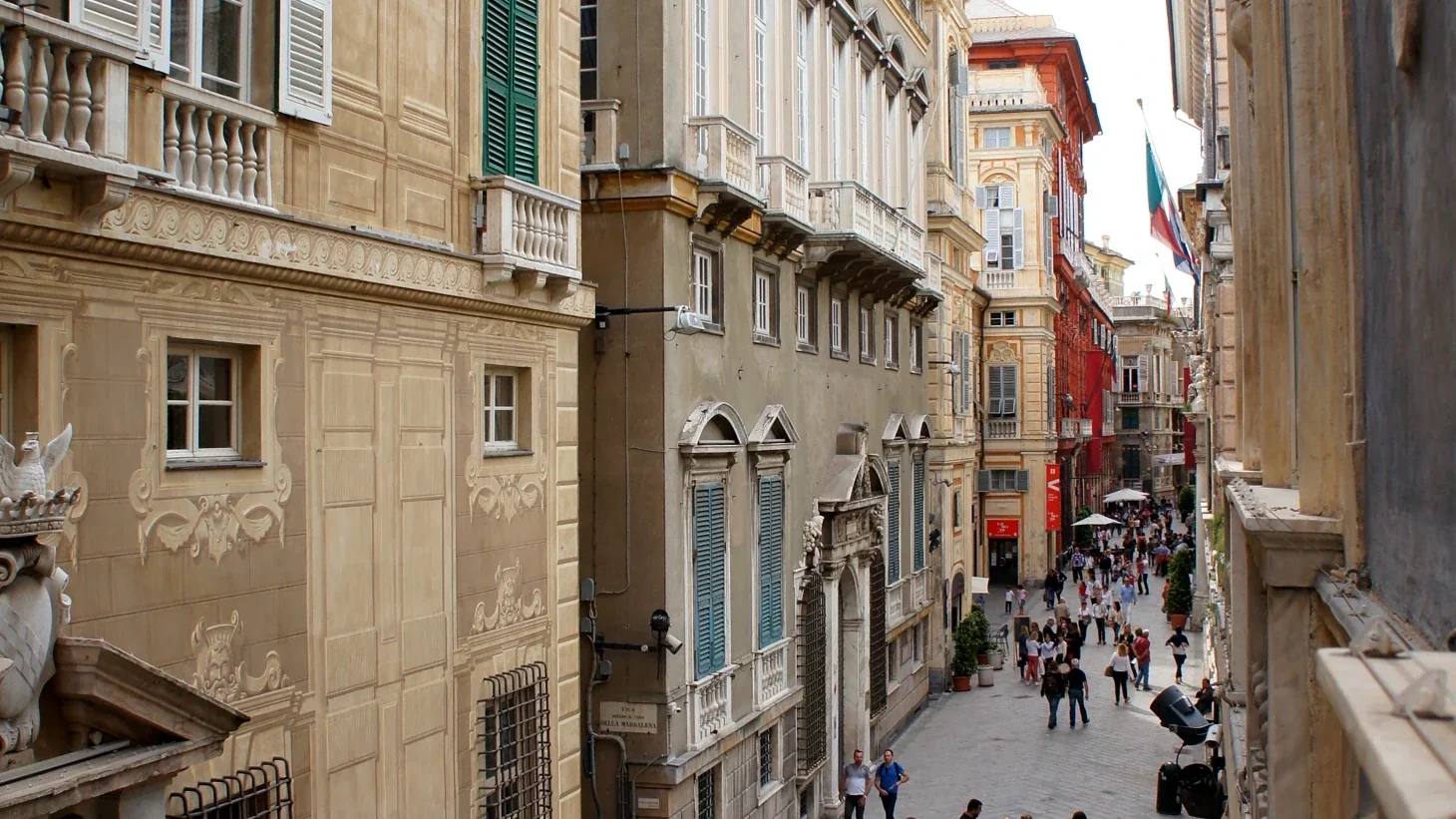
Genoa's old town is the largest maze of carruggi in Europe, and you do not understand it by following a single street: it is a system of lanes, squares, churches and palaces built between the port and the hill. A route that works alternates the main axes with detours, and allows for getting a little lost.
But before walking it is worth knowing what you are looking at, because the most interesting thing about Genoa is not visible: it is a mechanism.
What the Rolli actually were
In the sixteenth century the Republic of Genoa had a problem: it was immensely rich and it had no royal palace in which to lodge state guests.
The solution, fixed by laws of the Senate in 1576, is one of the strangest bureaucratic inventions of the age. The private palaces of noble families were classified by value and quality and entered on official lists — the rolli. When a dignitary arrived on a state visit, a lottery decided which family had the burden and the honour of hosting them, on behalf of the Republic.
This was not private hospitality: it was public lodging inside private houses, compulsory, decided by lot. The scale of those palaces is not family vanity, it is competition between families to appear in the top band of the list.
In 2006 UNESCO inscribed "Genoa: Le Strade Nuove and the system of the Palazzi dei Rolli" on the World Heritage list: not only the buildings, but the system. Forty-two palaces are inscribed, out of a system that counted 163 and out of more than a hundred still standing in the old town, built between the late sixteenth and early seventeenth centuries.
One thing to know before planning the walk
The 42 Rolli cannot all be visited in the same way. Some are museums with a ticket; others are public offices, banks or workplaces where you get no further than the courtyard; others again are private homes that open only on the special days devoted to them.
Before building a "Rolli itinerary", then, it is worth checking palace by palace which of the three cases applies. It is the difference between a satisfying day and an afternoon spent in front of closed doors.
The walking route
From De Ferrari to San Lorenzo
Piazza De Ferrari is the natural starting point: there is the metro and there is Palazzo Ducale, which hosts exhibitions and events on a programme that changes through the year.
From there you reach the cathedral of San Lorenzo, with its banded black and white façade and the bell tower finished in 1522, some sixty metres high.
Inside there is something you do not forget. During the bombardment of 9 February 1941 a 381 millimetre shell pierced the cathedral roof, bounced on the floor and did not explode. It is still there.
Into the carruggi
From San Lorenzo you can go down towards the port or into the historic lanes. There is no correct route: the carruggi are narrow, tall, in shadow, and the feeling of not knowing quite where you are is part of the visit.
It is worth having a map and a couple of fixed reference points — San Lorenzo, piazza Banchi, the port — to find yourself again when you need to.
Piazza Banchi and the port
Piazza Banchi and the San Giorgio area link the old town to the Porto Antico. From here you either carry on towards the Aquarium or climb back up towards via Garibaldi: they are two different days and it is better to pick one.
Via Garibaldi
This is the Strada Nuova, and it concentrates the system's most representative palaces. Palazzo Rosso, Palazzo Bianco and Palazzo Doria-Tursi form the Musei di Strada Nuova.
Palazzo Doria-Tursi holds Paganini's violin, known as il Cannone. Paganini was Genoese, and he was also one of the famous prisoners of the Torre Grimaldina, inside Palazzo Ducale: two stops on this route held together by the same person.
Finishing at Castelletto
The right ending is to go up to the Spianata Castelletto on the public lift, an Art Nouveau installation from 1909 that takes 45 seconds. From up there you see the structure of the city — the port, the roofs, the hill — and everything you have walked through takes shape.
How long it takes
- Half a day without going into the museums.
- A full day with the Musei di Strada Nuova and an unhurried visit.
Going up without the stairs
The old town is all uphill, but the public lifts do most of the work. From Galleria Garibaldi, between piazza Portello and largo Zecca, the Castelletto Ponente lift runs up to the Spianata every day from 6.40 to 24.00; the Castelletto Levante lift starts from piazza Portello and climbs 57 metres, with the same hours. From via Balbi, a short walk from Principe station, the Castello d'Albertis lift goes up to corso Dogali: weekdays 7.10 to 19.50, Sundays and holidays 7.15 to 20.55. The ordinary city ticket is valid — €1.20 a single ride, €4.00 for a book of four — and it is the easiest way up with a pushchair or luggage.
AMT hours and fares, checked on 31 August 2026.
Frequently asked questions
What are the Palazzi dei Rolli?
They were noble residences entered on official lists — the rolli — established by laws of the Genoese Senate in 1576. A lottery decided which family had to lodge state guests visiting the Republic: a system of public lodging inside private houses.
How many Palazzi dei Rolli are UNESCO World Heritage?
Forty-two, inscribed in 2006 as part of the site "Genoa: Le Strade Nuove and the system of the Palazzi dei Rolli". The historic system counted 163, and more than a hundred still stand in the old town.
Can you visit all the Rolli?
No, and not in the same way: some are museums with a ticket, others are banks or offices where you see only the courtyard, others are private homes that open only on dedicated occasions. It is worth checking palace by palace before planning the walk.
What can you see in Genoa's old town in half a day?
Piazza De Ferrari and Palazzo Ducale, the cathedral of San Lorenzo, the carruggi towards piazza Banchi, and via Garibaldi with the Musei di Strada Nuova. To finish, the climb to Castelletto on the public lift.
Is there really an unexploded shell in Genoa cathedral?
Yes: a 381 millimetre shell that on 9 February 1941 pierced the roof of San Lorenzo, bounced on the floor and failed to explode. It is kept inside.
Do people get lost in Genoa's old town?
It is the largest maze of carruggi in Europe, so yes, it happens — and it is part of the experience. With a map and two or three fixed points such as San Lorenzo, piazza Banchi and the port, you find your way again easily.