 Soggiorna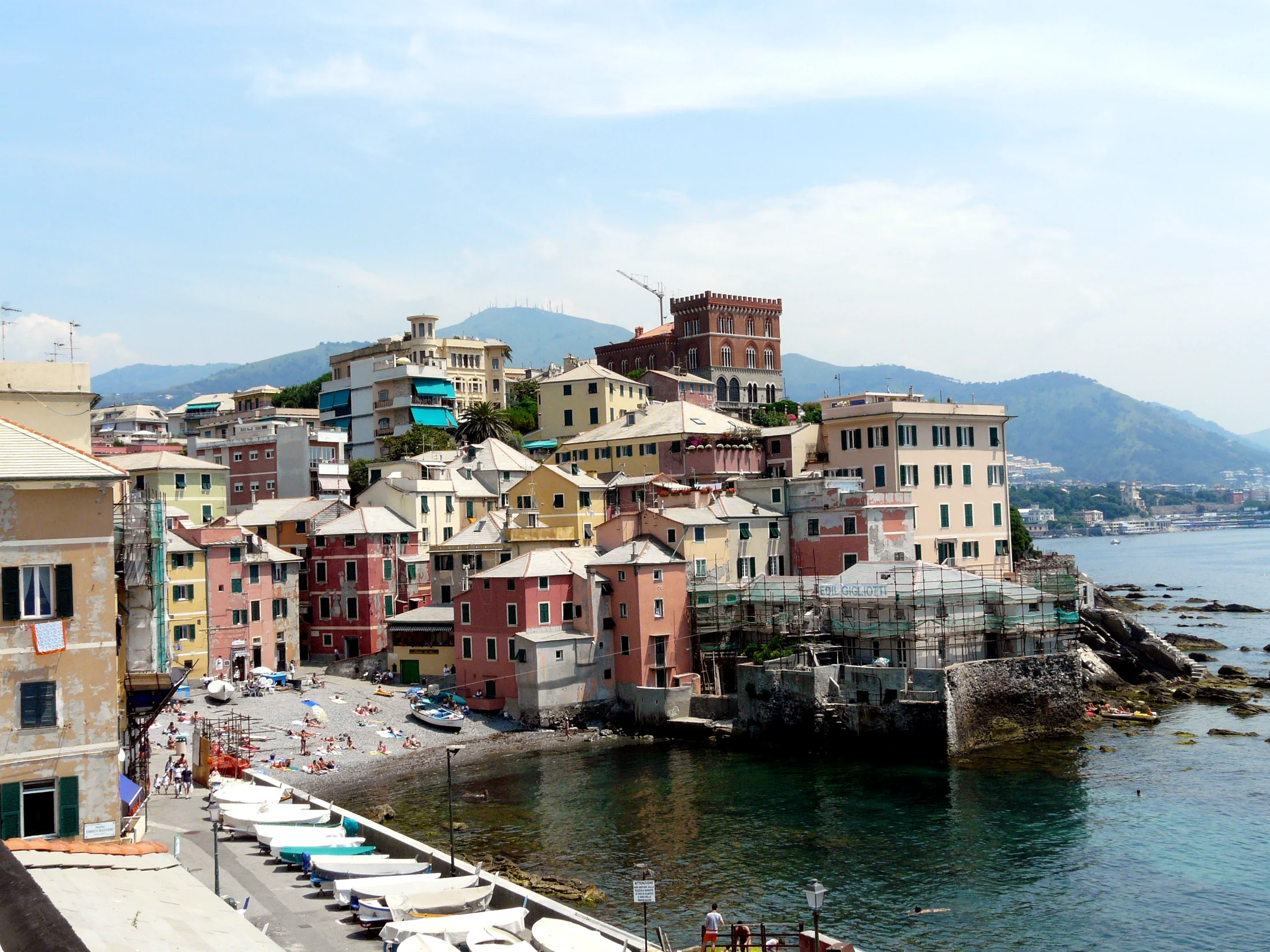
Anyone arriving in Genoa for the first time looks for the sea at the Porto Antico and finds a harbour: a handsome one, but a harbour, with the Aquarium and the ships. Genoa's sea, the kind you sit beside and look at the horizon, is to the east, and it begins where the centre ends.
They are three different things at three different distances, and they are not joined up: to see them in a single day you need transport. Worth knowing before you set off convinced you can walk it.
Corso Italia
This is the great seafront promenade east of the centre, and it is where Genoa goes to walk, run and sunbathe on the rocks. It is not a picture-postcard esplanade with palm trees: it is a wide road above the open sea, heavily used by locals and little by tourists.
You walk it end to end and it finishes at Boccadasse, which is why most people start along it in the first place.
In heavy seas it can be closed in whole or in part: it happens more often than you would think, and the closures are worth respecting — the sea really does come over the road.
Boccadasse
It is the most famous of the old fishing villages still visible in Genoa, between Corso Italia and Capo Santa Chiara. Tall narrow houses that seem to climb over one another to look out at the beach, painted in pastel colours with green shutters. At the bottom, a small pebble beach that is the heart of the place.
One thing has to be said, because it is why some people come away disappointed: it really is small. It is not a district, it is a handful of houses around a little beach. On summer evenings and at weekends there are more people than beach, and the queue for ice cream is part of the experience.
That takes nothing away from the place: it takes away the wrong idea that it is a seaside resort. It is a living postcard inside a city of eight hundred thousand people, and it should be taken as that.
Vernazzola, which is what the locals answer
A little further on is Vernazzola, also a fishing village and in the past an important trading landing, with its old houses and alleys intact.
The Genoese consider it the less touristy alternative to Boccadasse, and that is exactly how to use it: same idea, same sea, a tenth of the people. If you get to Boccadasse and find it packed, the answer is not to turn back.
Nervi
Nervi is something else again, and it is the reason it is worth taking the train.
The Passeggiata Anita Garibaldi is a pedestrian seafront path of almost two kilometres, from the little harbour of Nervi to the beach at Capolungo, cut between the rock and the water. From there the view reaches the Portofino promontory. There is no traffic and there are no junctions: you just walk, and it is one of the finest coastal walks in Liguria — inside the city of Genoa.
From the path you enter the parks of Nervi: 92,000 square metres of urban park formed by joining the estates of noble Genoese families, with around a hundred botanical species including palms and cedars, and five trees of monumental interest.
And inside the parks are the museums of Nervi — Wolfsoniana, Luxoro, Raccolte Frugone and the GAM — which within a square kilometre hold the city's collections of modern and contemporary art: paintings, sculpture, graphic work, furnishings and decorative arts.
A promenade, a park and four museums in the same place, reachable on an urban train ticket: if you have half a day and want one single thing, this is the one single thing.
How they fit together
They are not adjacent, and that is the practical point that decides the day.
- Corso Italia and Boccadasse go together: you walk the promenade and arrive at the village on foot.
- Vernazzola is a little past Boccadasse, still on foot.
- Nervi is further out and is reached by urban train from Principe or Brignole, which is quicker than the bus and drops you practically on the promenade.
Half a day is enough for Corso Italia plus Boccadasse, or for Nervi. For both you need a full day and the willingness to walk.
Swimming, put honestly
Genoa is a port city and the sea to the east is rock and pebbles, not sand. People do swim, the locals do it all summer, but anyone after a wide beach with a sun lounger needs to take the train further east, towards the Tigullio.
For a day of sea and city, though, this coast does what it promises.
Frequently asked questions
How do you get to Boccadasse from central Genoa?
On foot along Corso Italia, the seafront promenade east of the centre, which ends right at the village, or by bus. There is no metro: the line stops at Brignole.
Is Boccadasse worth visiting?
Yes, as long as you know what it is: a very small fishing village — a handful of pastel houses around a pebble beach — inside a big city, not a seaside resort. On summer weekends it is crowded.
What is the less touristy alternative to Boccadasse?
Vernazzola, a little further along the same coast: also a fishing village, with its old houses and alleys intact, and far fewer people. It is the one the Genoese choose.
What is there at Nervi?
The Passeggiata Anita Garibaldi, almost two kilometres of seafront path from the little harbour to the beach at Capolungo, the parks of Nervi with 92,000 square metres of green space and around a hundred botanical species, and four museums — Wolfsoniana, Luxoro, Raccolte Frugone and GAM — within a square kilometre.
How do you get to Nervi?
By urban train from Principe or Brignole: it is quicker than the bus and the station is a few steps from the promenade.
Are there sandy beaches in Genoa?
Not along the eastern shore: the sea there is rock and pebbles. People swim all summer, but for a sandy beach you have to move further east, towards the Tigullio.