 Soggiorna
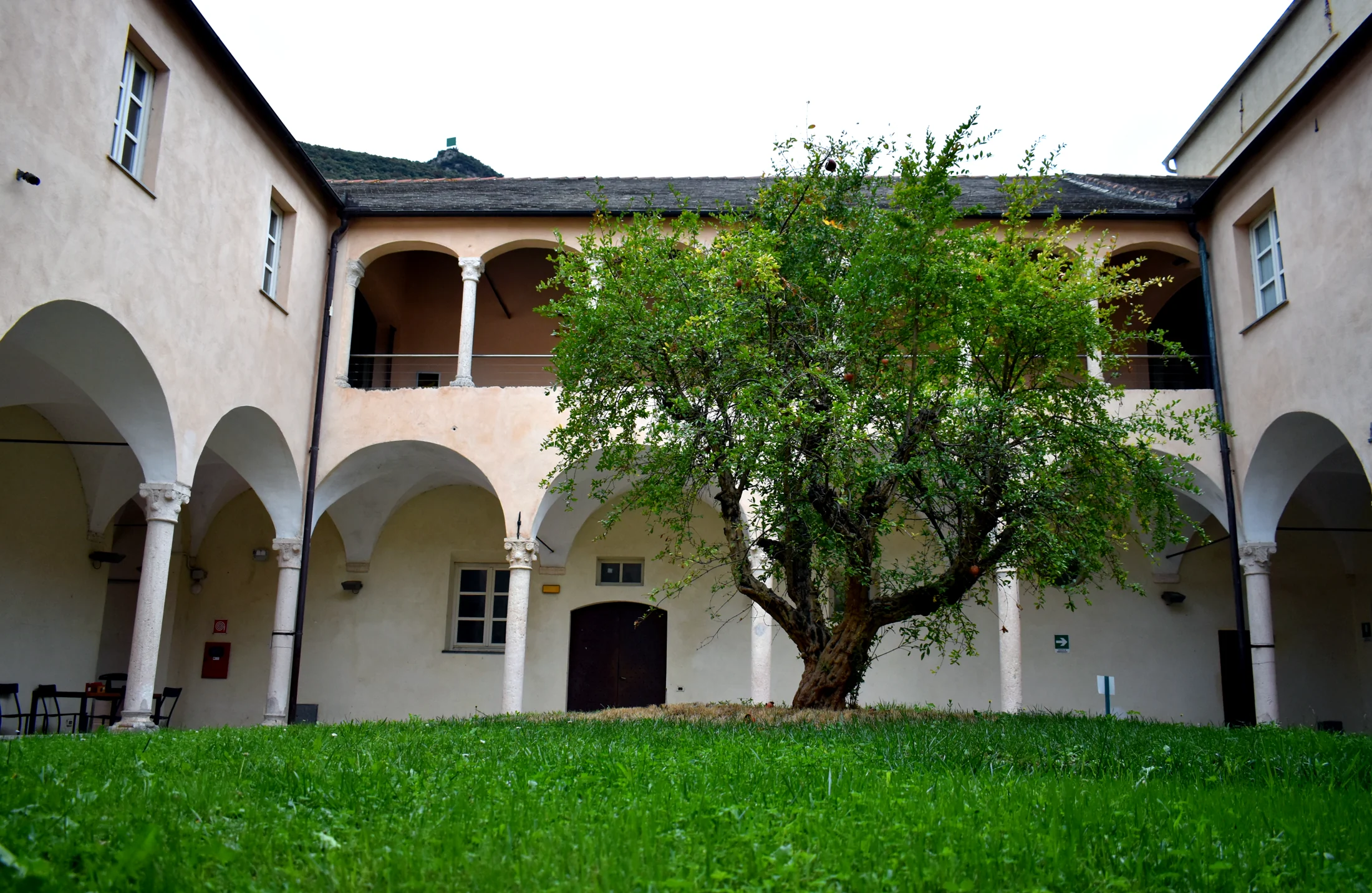
Finalborgo is the historic centre of Finale Ligure, but it is not on the sea: it lies a kilometre and a half inland, enclosed by its walls, where the Pora and Aquila streams meet. It was the capital of the Marquisate of Finale, the state of the Del Carretto family that lasted until 1602, when Finale passed to Spain. The town is small and takes a couple of hours to walk round; the museum and the castles fill the rest of the day. This guide follows the order of a walk, with opening hours where they exist.
The walls and the gates
The walls date from around 1447, built by Giovanni I del Carretto, and survive almost intact. There are three main gates: Porta Testa, the one you reach coming from Finalmarina, Porta Reale and Porta Romana. It is worth entering through Porta Testa and leaving by another, to see the town from two sides. From Finale Ligure station to Porta Testa is 1.5 kilometres, about twenty minutes on foot; alternatively, TPL bus line 40/ runs to Finalborgo.
One detail you notice everywhere: doorways, columns and jambs are made of Pietra di Finale, the pinkish-white limestone of the plateau and the only Miocene rock in Liguria.
The Santa Caterina complex and the museum
This is the heart of the town. The Dominican church and convent of Santa Caterina have two cloisters built at the end of the 15th century thanks to Carlo Domenico Del Carretto, who became a cardinal in 1505. In the chapel of Santa Maria degli Oliveri, in the right apse of the church, is one of the most important cycles of medieval frescoes in Liguria.
The cloisters house the Archaeological Museum of Finale: ten rooms running from the geography of the area through prehistory, the Romans and Byzantine Liguria to the Middle Ages of the Del Carretto, with a final room on coins. The piece everyone looks for is the Young Prince, the burial of a Palaeolithic boy found in 1942 in the Arene Candide cave.
Opening hours, from the museum's website:
| Period | Days | Morning | Afternoon |
|---|---|---|---|
| 15 September – 14 June | Tuesday – Sunday | 9 – 12 | 2.30 – 5pm |
| 15 June – 14 September | Tuesday – Sunday | 10 – 1pm | 4 – 7pm |
Closed on Mondays. Tickets: full 5 euros; reduced 3 euros (over 65s, young people up to 16, groups of 10 or more, university students); family 10 euros for two adults and at least one child under 12; free under 6. On Sunday mornings, if you book by phone, you can climb the bell tower of Santa Caterina for 2 euros. The museum has no internal architectural barriers and offers free audio guides in four languages, played on your phone via a QR code; for children there is an audio route narrated by the Young Prince. Phone: +39 019 690020.
The basilica of San Biagio
This is the town's Baroque church. The community decided to build it in 1634, the work was entrusted to the architect Andrea Storace and dragged on: the basilica was only consecrated in 1690. Inside, look at the marble, the white marble pulpit and the balustrade with angels.
Teatro Aycardi and Palazzo del Tribunale
The Teatro Aycardi hides behind a curved façade painted with trompe-l'oeil architecture, on the square that bears its name. It was built in 1804–1806, in the Napoleonic era, in the rooms of a college founded in 1759: according to the museum it is the oldest 19th-century theatre with stalls and boxes surviving in Liguria. It can be visited during the scheduled openings of the Museo Diffuso del Finale (MUDIF), for a free-will donation.
The Palazzo del Tribunale has been "the palace where justice was administered" since the Middle Ages, an example of the architecture of power; today it hosts workshops and theatre activities.
Castel San Giovanni
The fortress you see above the town was built in 1642–1643 by the military engineer Francesco Prestino, in the service of Spain. From Porta Testa it is about 600 metres, all uphill. Inside is a tactile model of the building at a scale of 1:1000, with a Braille panel. From up there you see the whole of Finalborgo from above, and it is the photo almost everyone takes.
Castel Gavone and the Diamond Tower
Castel Gavone, on the hill behind the town, is the symbol of Finale. Founded in the 12th century, it was the residence of the Del Carretto marquises. The Diamond Tower, with its pointed, faceted stones, is considered one of the most important examples of Renaissance fortified architecture in Italy.
The thing to know before you climb: it can only be visited on a guided tour led by an archaeologist, with compulsory booking on +39 019 690020. Dates are in the museum's calendar. The town's tourist website gives 10 euros full and 7 reduced for individual visitors. From the Santa Caterina complex the castle is about 1.3 kilometres uphill, along the strada Beretta.
Val Ponci and the Roman bridges
If you have half a day left, Val Ponci is the outing to make. The name comes from vallis pontium, "the valley of bridges": for about two kilometres you walk on the line of the via Iulia Augusta, the road opened by Augustus in 13 BC, and you meet the remains of five bridges. The first, the ponte delle Fate, is the best preserved and can still be crossed; then come the ponte Sordo, the ponte delle Voze, the ponte dell'Acqua and the Magnone bridge, in the woods near the Colla di San Giacomo. Between the Voze and Acqua bridges a short path leads to the Roman quarries of Pietra di Finale, dug as tunnels.
Sources disagree on the age of the bridges: the town's tourist website says they may date from Hadrian's time, while the Finale Outdoor Region consortium considers them medieval. The start is the hamlet of Verzi, reached by car from Calvisio; the valley is done on foot or by mountain bike, and the museum runs guided archaeo-trekking visits. By bike there is the Ponti Romani trail, one of the easiest in the area.
The Arene Candide cave
This is the Young Prince's cave, one of the most important in Europe for its finds: the route led by archaeologists goes back to about 30,000 years ago. Here too entry is only on a guided tour, with compulsory booking on +39 019 690020. Holders of a full cave ticket get the reduced museum price.
A half-day walk
- Enter through Porta Testa.
- Santa Caterina: cloisters and museum (a good hour and a half).
- San Biagio and the Teatro Aycardi, a few steps away.
- Climb to Castel San Giovanni for the view.
- Back through the lanes and out by another gate.
Add Castel Gavone and the Arene Candide only if a guided visit is on the calendar.
Frequently asked questions
How long does it take to visit Finalborgo?
The town takes a couple of hours to walk round. With the Archaeological Museum and the climb to Castel San Giovanni, allow half a day.
Can you visit Castel Gavone on your own?
No: it can only be visited on a tour led by an archaeologist, with compulsory booking on the museum's number, +39 019 690020.
Is the Archaeological Museum of Finale open on Mondays?
No, it is closed on Mondays. It is open Tuesday to Sunday, with winter and summer hours.
How much does the Archaeological Museum of Finale cost?
Full 5 euros, reduced 3, family ticket 10 euros; free for children under 6.
Where are the Roman bridges of Finale Ligure?
In Val Ponci, above Finalborgo: you start from Verzi and follow about two kilometres of the old via Iulia Augusta, with five bridges.