 Soggiorna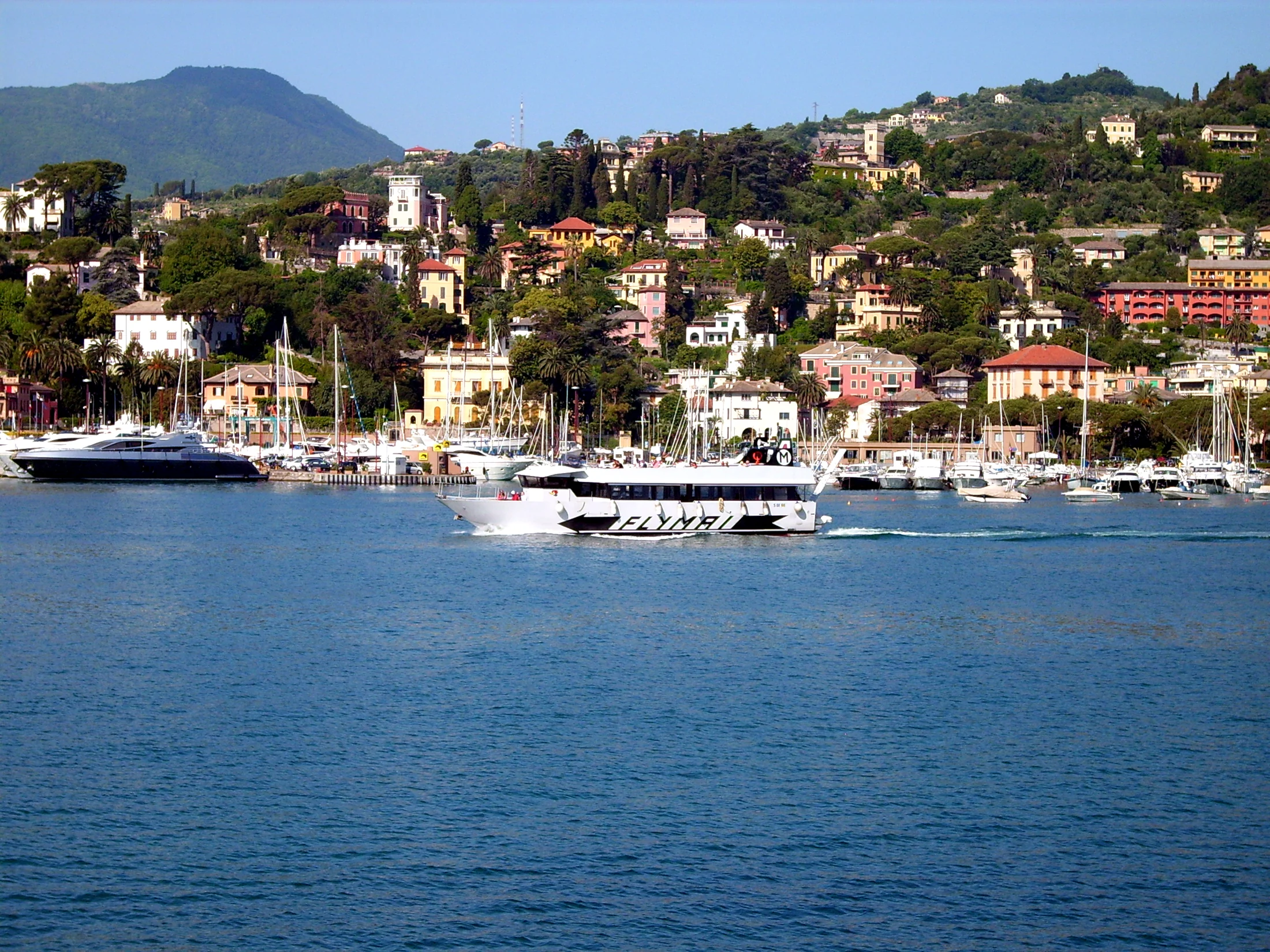
Rapallo sits at the head of the Gulf of Tigullio, in the province of Genoa, and it has one feature that sets it apart from the more famous places around it: it is a town that lives all year round, not a village that fills up in July and shuts in September. That changes a good deal for anyone sleeping here.
This page is here to help you decide whether it is the right place for your trip. The other Rapallo guides go into detail on what is only sketched here.
Why it works as a base
Portofino and Santa Margherita are more photogenic. Rapallo, on the other hand, has all four of the things you need in order to move around:
- the railway station on the Genoa-La Spezia line, opened in 1868 and served by the regional trains that stop all along the coast;
- the A12 motorway junction on the Genoa-Livorno route;
- the boats that leave the pier for Santa Margherita, Portofino and San Fruttuoso;
- the cable car up to the sanctuary of Montallegro, which is a means of transport and not a paid attraction.
In practice that means you can spend the day in Portofino or San Fruttuoso and come back in the evening to a place where the shops are open, you buy your bread downstairs and dinner does not require a booking made in March. Sleeping here costs appreciably less than two kilometres away on the same coast, and the difference is not one of quality: it is one of address.
Who it does not suit
Worth saying up front, because it is the main reason anyone ends up disappointed.
If you are after miles of open sand, this is not the right coast. The Tigullio beaches are largely shingle and largely occupied by beach clubs, and at Rapallo the shore is not one single beach but a run of different stretches: the town seafront, the castle area and three small coves beyond the harbour. There is exactly one free beach whose shore comes close to sand, Le Saline. Anyone wanting a wide beach should look to the western Ligurian coast.
If you are after the picture-postcard village, that is Portofino and it is half an hour away by boat: Rapallo is a real town, with the traffic and the apartment blocks of a real town.
What there is
The castle on the water is the town's emblem: a sixteenth-century fortress on a rock at the water's edge, thrown up after the Ottoman fleet sacked the town in 1549. Today it hosts exhibitions, and the stretch of seafront you look at it from is where the whole of Rapallo walks in the evening.
Behind the town, on the hilltop, stands the sanctuary of Nostra Signora di Montallegro, tied to the apparition of 1557 to a local farmer, Giovanni Chichizola. You go up by cable car: 600 metres of ascent in eight minutes. It is the first thing to do, because from up there you see the whole gulf — Portofino on one side, the coast towards Sestri Levante on the other — and once you have seen it the rest of the stay makes more sense.
In the old town there are the carruggi, the narrow lanes, the medieval bridge tradition attributes to Hannibal (the attribution is legend, the bridge is old regardless) and the bobbin lace tradition, with a museum devoted to it at villa Tigullio, inside Parco Casale.
Outside the centre, beyond the harbour, lies San Michele di Pagana: three coves and a church attested as early as 1133 that holds a Crucifixion by Van Dyck — the only altarpiece the artist painted in the whole of Liguria. It is the least known thing in Rapallo and one of the few that is worth a journey.
When to go
- June and September are the best months: the sea is still good, prices are lower, there are no queues.
- July and August are full. In the first days of July there is the Montallegro festival, which is the town's own: it changes the rhythm of everything and is worth factoring in before you book, one way or the other.
- In winter the town stays alive — that is the advantage of not being a seasonal village — but the boats cut back their sailings and the cable car closes for maintenance, usually in November and January. Anyone coming to walk the Portofino promontory, though, finds the best season.
The car: the one thing to decide in advance
Parking in Rapallo is almost all paid and the centre is tight. If the place you are staying offers a space, ask for it and confirm it when you book, not on arrival.
And if the plan is to stay in the area, give serious thought to leaving the car parked all week: between the trains and the boats you can get anywhere, which is why this is one of the spots on the coast where a car is least useful.
Frequently asked questions
Why sleep in Rapallo rather than Portofino or Santa Margherita?
Because Rapallo is a town that lives all year round, with a station, a motorway junction, boats and a cable car, and it costs appreciably less while being on the same coast. Portofino and San Fruttuoso are reached by boat from the pier and visited for the day.
Are Rapallo's beaches sandy?
Largely not. The shore is a run of different stretches, mostly pebbles and rock, and largely taken up by beach clubs. The free beach whose shore comes closest to sand is Le Saline, on the town seafront.
How long do you need to visit Rapallo?
Two days is the right length: one for the town and the cable car up to Montallegro, one for the trip out to sea towards Portofino or San Fruttuoso. With only half a day, take the cable car.
Do you need a car in Rapallo?
No, and it is one of the places on this coast where you need one least: the station is on the Genoa-La Spezia line and the boats leave from the pier. Parking in town is almost all paid, so if you do have a car it is worth asking your accommodation whether they have a space.
When is the best time to go to Rapallo?
June and September: the sea is still good, prices are lower and there are no queues. In the first days of July the Montallegro festival fills the town.