 Soggiorna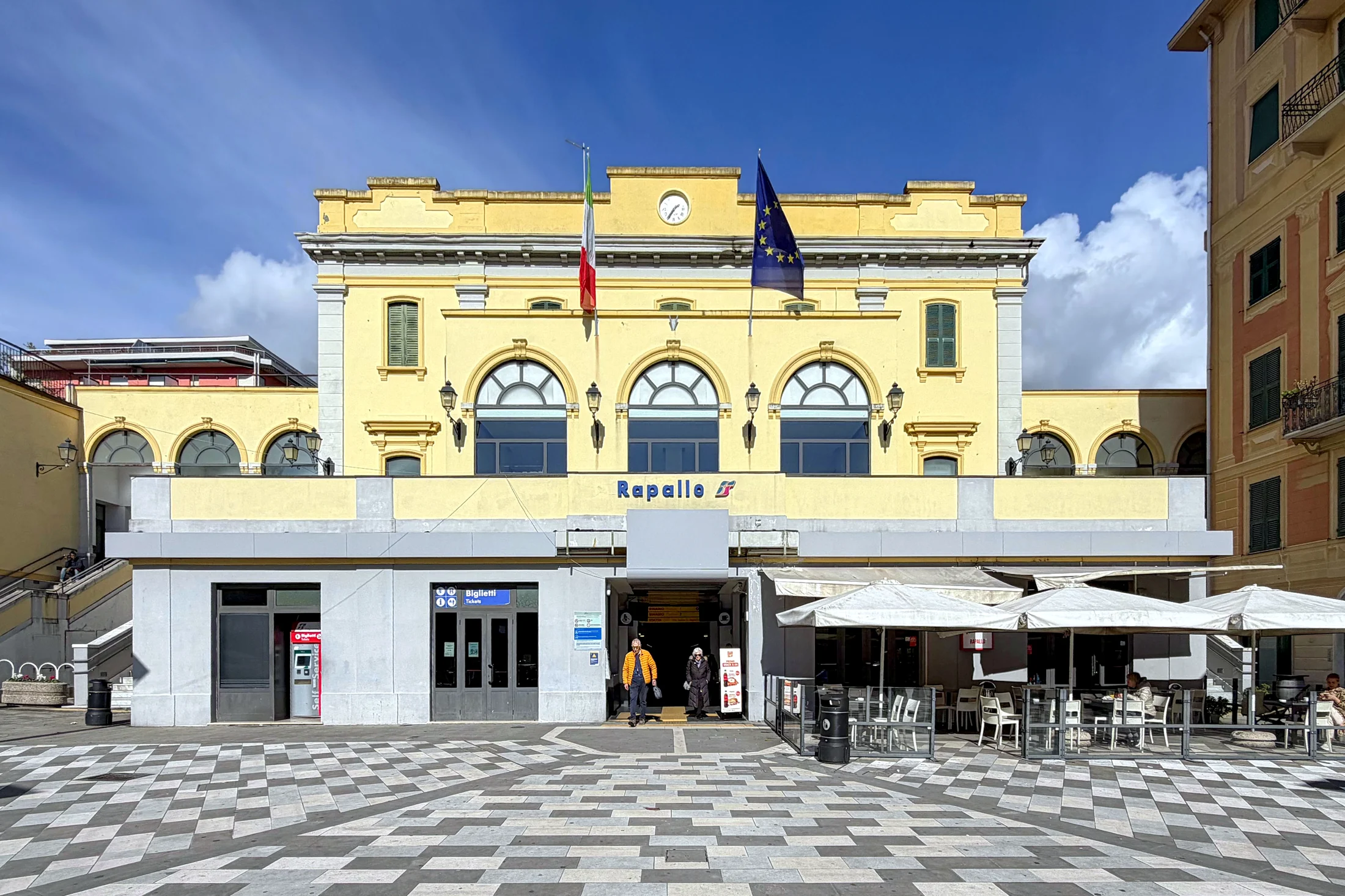
Rapallo is one of the places on the Ligurian coast where a car is least useful, and where keeping one is more trouble than leaving it at home. It is worth knowing before you set off, because how you arrive changes everything else about the holiday.
By train
The station is on the Genoa-La Spezia line, opened in 1868 and served by the regional trains that stop all along the coast. It is the simplest way to arrive, and it is also how you visit the neighbouring towns: Santa Margherita, Zoagli, Chiavari and Sestri Levante are all a few minutes away, and from Genoa it takes a little under forty minutes.
The station has an automatic ticket machine open 24 hours a day for regional services, as well as a staffed ticket office.
If the journey starts at an airport, the reference point is Genoa, on the same line.
By car
The A12 Genoa-Livorno junction is the Rapallo one. That far, it is easy. Then the real part begins.
Where to park
Parking in Rapallo is almost entirely paid: no free car park appears in the town's list of parking areas. The centre is tight, and in July and August finding a space near the sea in the middle of the day is a matter of luck, not of timing.
The car parks fall into three zones. Capacities are approximate.
| Zone | Car park | Spaces |
|---|---|---|
| Harbour | Porto di Rapallo and via Langano | about 150 |
| Harbour | Largo Aldo Moro and via Dante | about 40 |
| Centre | Piazza IV Novembre | about 150 |
| Centre | Piazza delle Nazioni | about 30 |
| Centre | Via Gramsci | 15 |
| Outside the centre | Via Betti | about 160 |
| Outside the centre | Piazza Cile | about 25 |
| Outside the centre | Via della Vittoria | 14 |
Three observations the list alone does not give you:
- The two that matter are Piazza IV Novembre and the harbour. They are the largest ones close to the centre, and they are also the first to fill.
- Via Betti is the biggest on the list, and it is where the cable car leaves from. The valley station of the Montallegro line is at piazzale Federico Solari, in the Betti quarter: if the day starts with going up to the sanctuary, leaving the car there means not having to move it for the first thing you do.
- Via Gramsci and via della Vittoria are best forgotten for planned parking: with 15 and 14 spaces, either you are lucky or you waste time trying.
The permits, and the question to ask your accommodation
The council runs several passes: for residents (free parking in reserved bays and a reduced rate in the blue zones), for expectant and new mothers (unlimited parking in disc zones), for craftspeople, and permits for entering and parking in the pedestrian area — including hotel parking, handled through a platform.
For an arriving visitor this means one thing, and it is the right question to ask: if the place you are staying has a parking space or a permit, ask for it and get it confirmed when you book, not on arrival. Not all of them qualify and not all of them offer it, but it is the one thing that can take the problem away entirely — and on arrival, if the answer is no, there is nothing left to arrange.
If there is none, allow for a paid car park and a few minutes on foot. And if the plan is to stay in the area, give serious thought to leaving the car parked all week: between the trains and the boats you can get anywhere.
The boats, which are the real reason to be here
From the pier there are seasonal connections to Santa Margherita Ligure, Portofino and San Fruttuoso. It is the best way to reach Portofino: the road there is narrow, parking is expensive and limited, and arriving from the sea is nicer anyway.
San Fruttuoso, moreover, can be reached only by boat or on foot along the promontory paths: there is no road, and that is exactly what has kept it as it is.
Sailings are seasonal and in rough seas they can be cancelled: that is the thing to check the evening before.
The cable car to Montallegro
It leaves from piazzale Federico Solari and climbs to the sanctuary on the hill: 600 metres of ascent in eight minutes, two cabins holding 24 people. It is the only aerial cableway of its kind working in Liguria.
It is a means of transport, not a paid attraction, and it is the quickest way to get the whole gulf in front of you. It closes for maintenance usually in November and January.
Worth remembering
- Boat and cable car times change with the season: check them the day before, they are the thing that wrecks plans.
- In winter the boats cut back sharply and the cable car may be closed.
- Parking does not book itself: if you need it, you have to ask in advance.
Frequently asked questions
How do you get to Rapallo without a car?
By train: the station is on the Genoa-La Spezia line, served by regional trains, and from Genoa it takes a little under forty minutes. From the same line you reach Santa Margherita, Zoagli, Chiavari and Sestri Levante in a few minutes.
Is there free parking in Rapallo?
None appears in the town's list of car parks: parking is mainly paid. The largest are via Betti, the harbour with via Langano, and piazza IV Novembre, all around 150-160 spaces.
Which is the best car park in Rapallo?
It depends on what you do first. Piazza IV Novembre and the harbour are the handiest for the centre and the seafront; via Betti is the largest and it is in the quarter the Montallegro cable car leaves from, so it suits you if the day starts there.
How do you get to Portofino from Rapallo?
By boat from the pier: it is the best way, because the road is narrow and parking in Portofino is expensive and limited. The connections are seasonal and in rough seas they can be suspended.
How do you reach San Fruttuoso?
Only by sea or on foot along the paths of the Portofino promontory: there is no road. The boats leave from the pier at Rapallo and are seasonal.
Do you need a car to visit Rapallo and the area?
No. Between the trains, the boats and the cable car you can reach everything, and parking in town is almost entirely paid: if you are staying in the area, leaving the car parked for the whole trip is often the easier choice.