 Soggiorna
With children, guides list attractions. At Bordighera you need to know one thing instead, and it shapes the whole day: the town is on two levels.
Below is the lower town, flat and largely pedestrian. Above is the medieval village, and you get there uphill. It is not a climb, but it is a real slope, and with a loaded pushchair you feel it. There is no flat shortcut: looking for one wastes time.
From here on, everything is organised around that gradient.
The easy part: two kilometres without a step
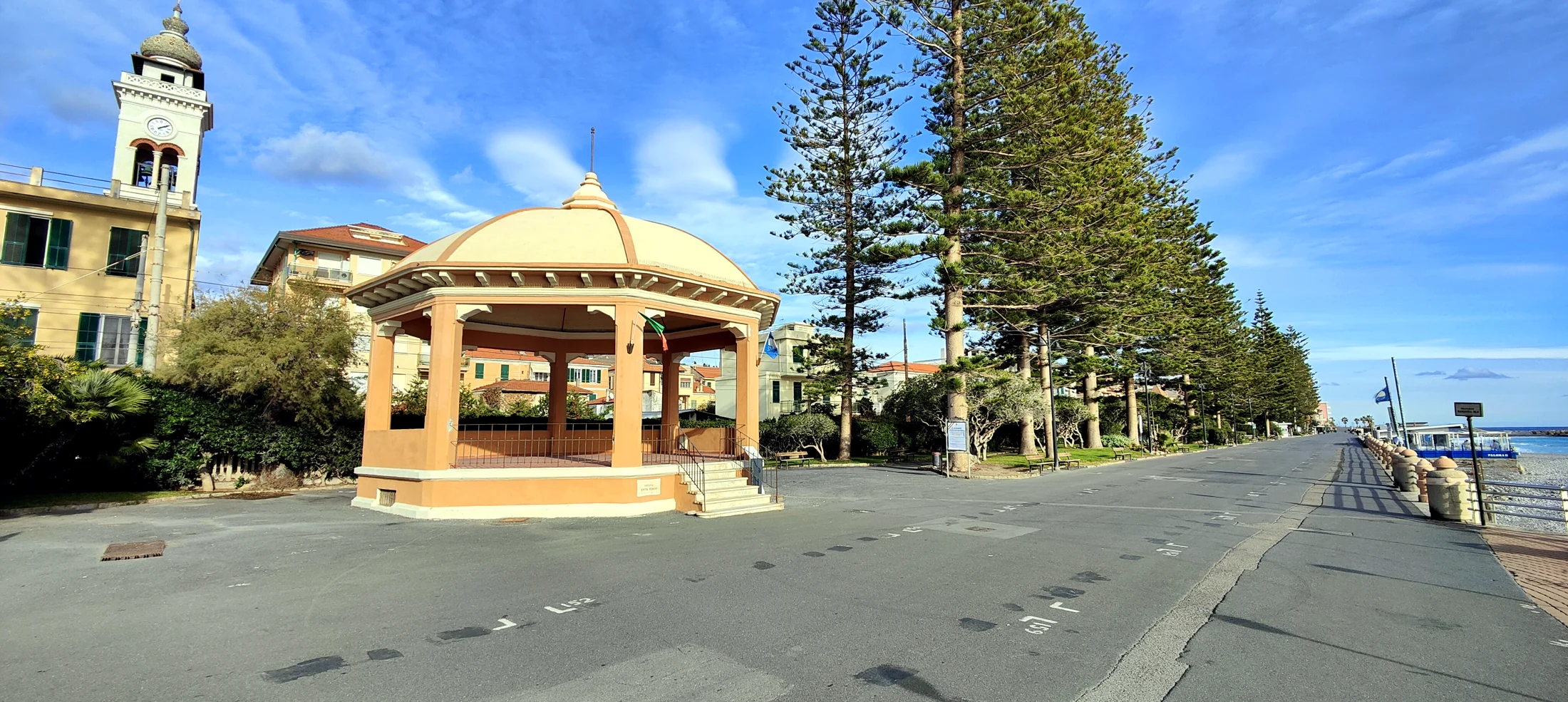
The Lungomare Argentina is the longest pedestrian promenade on the western Riviera: two kilometres with no traffic and no gradient.
With children this is the town's real asset. You go up and down with the pushchair, older ones run or cycle, and there is not a single road to dash across. On this coast, where the seafront is almost everywhere a road with cars on it, that is a difference you feel by the end of the day.
It carries Argentina's name because Eva Perón inaugurated it in 1947, which is exactly the kind of detail children like precisely because it is unexpected.
The cactus garden, which sits on a volcano
If there is one thing to choose, it is this: the Pallanca Exotic Garden.
Three thousand varieties of succulents and cacti over a hectare of rock above the sea, collected by four generations of the same family. And the rock is not just any rock: the garden lies on the slopes of Monte Nero, an ancient volcano.
To children you put it like this, and it works: an extinct volcano covered in cacti, above the sea. Paid entry.
The towers, the gates and a story that tells well
Climbing to the village is easier with a reason. There are two, and both are true.
The first: the village was founded on one precise day, 2 September 1470, by thirty-two families who agreed on it in a church. It did not grow: it was decided.
The second is the better one. In 1586, in Rome, an obelisk twenty-five metres high was being raised in St Peter's Square, and the pope had ordered absolute silence on pain of death. When the ropes began to fail, a sailor from here, Benedetto Bresca, shouted anyway to wet them. He was right, and instead of being executed he won for his home town the right to send palms to the Vatican every year.
With older children there is a sequel that works even better: Sanremo says that sailor was theirs, and the two towns are still arguing about it now, every year, when the palms leave for Rome. Nobody has ever won the argument.
A man who risks his head to shout the right thing is a story that holds up all the way to the top of the slope. The rest is in Bordighera Alta: the village and the palms.
The sea: pack the water shoes
This has to be said plainly because it is the usual source of a ruined day: the beaches are pebble, not sand.
With children that means two things. Water shoes really are needed, and they should come from home. And no sandcastles: anyone with a child who spends hours digging should know in advance.
In exchange the clubs on the seafront have a pool, games and floating platforms with trampolines — equipment that exists precisely because the beach alone is not enough here. And the water, over pebbles, stays clear even when the sea moves: with a mask, older children have more fun than they would on sand.
The detail on free stretches, clubs and rocks is in beaches at Bordighera.
How the day fits together
The order matters more than the content, and here it is dictated by the sun and the slope.
- Early morning: the climb to the village, while it is still in shade and legs are fresh.
- Middle of the day: the cactus garden, or a museum indoors.
- Afternoon: down to the Lungomare Argentina and the beach, until evening.
Doing it the other way round means taking the slope at the worst hour, with tired children. It is the mistake that makes the day longer than it is.
Transport — the station is in town and the nearest airport is Nice — is in getting to Bordighera.
What is NOT here
Worth saying first:
- There is no aquarium and no amusement park. No attractions built for children.
- The hill village is not pushchair-friendly: a slope, then alleys and steps.
- There is no sand. That is what catches out anyone arriving from Alassio or Albenga.
What is here, and works, is a two-kilometre promenade with no cars, a cactus garden on a volcano and a story with a man risking his head in it. That is not nothing, but it is different from what the posters promise.
Frequently asked questions
Is Bordighera suitable for children?
Yes, with one caveat: the town is on two levels. The lower part and the two kilometres of the Lungomare Argentina are flat and pedestrian, ideal with a pushchair; the medieval village is above and you reach it uphill.
Can you get around Bordighera with a pushchair?
On the seafront, yes, perfectly: two kilometres with no gradient and no traffic. In the hill village, no: there is the climb, then alleys and steps.
What can you do at Bordighera with children when the sun is too strong?
The Pallanca Exotic Garden, with three thousand varieties of cacti on an ancient volcano, and the museums in the centre. The garden is outdoors but on a slope above the sea; the museums are indoors.
Are Bordighera's beaches good for children?
They are pebble, not sand: water shoes are needed and there are no sandcastles. In exchange the clubs have a pool, games and platforms with trampolines, and the water stays clearer than over sand.
Is there an aquarium or amusement park at Bordighera?
No. There are no attractions built for children: what works is the pedestrian seafront, the cactus garden and the stories of the village.