 Soggiorna
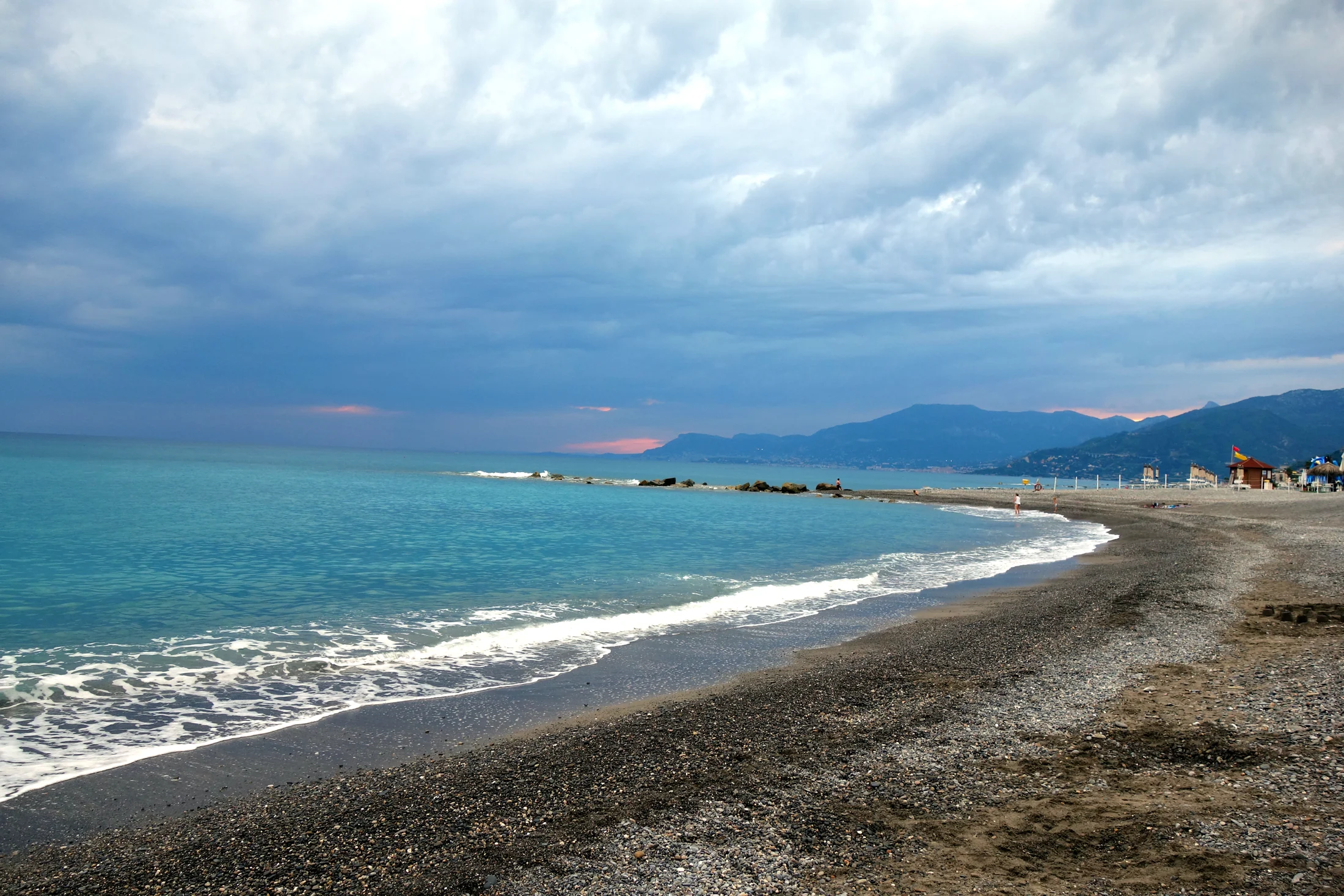
Let us start with the thing that sends disappointed people home: Bordighera's beaches are pebble, with stretches of coarse sand. It is not the sandy shore of Alassio and it is not the sand of Albenga.
Say that first, and the rest can be told for what it is — and what it is, is good.
What the shore is like
The coast runs parallel to the centre, and the stretch from the station to the Sant'Ampelio roundabout is the closest to the shops and the town: it is the one you use without organising anything, straight off the train.
Above it runs the Lungomare Argentina, two kilometres that make up the longest pedestrian promenade on the western Riviera. It carries Argentina's name because Eva Perón inaugurated it, in 1947: the only Ligurian seafront christened by a South American first lady.
Free stretches and beach clubs
Rattaconigli is the largest of the town beaches, largely free, with two clubs on it. It is the reference point for anyone who does not want to pay for a parasol and does not want to be cramped either.
Along the Lungomare Argentina, by contrast, the beach clubs line up, and here the difference from other resorts shows: they offer not just loungers but windsurf hire and lessons, floating platforms with trampolines, children's games, a pool, and in some cases evenings with music. This is the offering of an equipped resort, not of a village beach.
Prices and availability change every season and we do not print them: any figure here would be out of date before it was read.
Blue Flag and beach clubs
In 2026 Bordighera again holds the Blue Flag, both for its shoreline and for its marina. The town's tourist website publishes the list of beach clubs, almost all on the Lungomare Argentina, with address and phone number: that is where you book your umbrella.
Offshore lies the Cetacean Sanctuary. According to the town, fin whales, sperm whales, dolphins and pilot whales can be spotted even on a short boat trip, and a mask and snorkel are enough to see the life on the sea bed.
The Sant'Ampelio rocks, which are the best of it
Below the cape, at the foot of the eleventh-century church, are the rocks. This is not a beach: it is stone, and people go for one precise reason — it is where the water is cleanest in the whole town.
Swimmers, snorkellers and anyone who wants the sea without the noise of the parasols goes there. Anyone after comfort does not, and rightly so: there is no sand, no shade, and getting in takes hardened feet or water shoes.
It is the place where Bordighera resembles itself rather than any generic seaside resort.
Why the coast here is different
The reason the seabed is pebble rather than sand is the same reason this is Liguria's southernmost point: Capo Sant'Ampelio. A rocky headland that divides the shore and shapes the bottom on both sides of it.
In other words: the feature that makes Bordighera geographically remarkable is the same one that denies it a sandy shore. They are two faces of the same cape.
What NOT to expect
- It is not sand. With very small children, the ones who dig, the difference is felt keenly.
- It is not a wild beach. The shore is urban, serviced and busy: anyone after a deserted cove should go elsewhere.
- The promenade has no natural shade. Two open kilometres are glorious at six in the evening and hard at noon in August.
On pebbles, with children
Since it is the commonest question, here is the whole answer rather than a cross-reference.
Water shoes are not an accessory here: they are necessary. On hot pebbles and an uneven bottom, without them the day lasts half an hour. Pack them before leaving, because buying them locally in mid-August costs double.
In exchange the pebbles give something sand does not: the water stays clear even when the sea is choppy, because there is nothing to lift off the bottom. Anyone who brings a mask notices at once.
And the real compensation is at the clubs: a pool, games and floating platforms with trampolines exist precisely because the beach alone will not entertain a child. Here the equipment is not luxury, it is the answer to the seabed.
How to reach the sea without a car — the station is in town — is in getting to Bordighera. The full picture is in Bordighera: the complete guide.
Frequently asked questions
Are Bordighera's beaches sandy?
No: they are mainly pebble, with stretches of coarse sand. It is the thing to know before setting out, especially if you are coming from sandy resorts like Alassio or Albenga.
Which is the free beach at Bordighera?
Rattaconigli is the largest of the town beaches and is largely free, with two clubs on it. The stretch between the station and the Sant'Ampelio roundabout is the handiest for anyone arriving by train.
Where is the cleanest water in Bordighera?
On the Sant'Ampelio rocks, below the cape and the eleventh-century church. It is not a beach — it is stone — but it is the point with the best water in town, and the right place for snorkelling.
What do Bordighera's beach clubs offer?
Along the Lungomare Argentina, besides loungers and parasols, there is windsurf hire and tuition, floating platforms with trampolines, children's games and a pool; some run evenings with music.
How long is the Lungomare Argentina?
Two kilometres: the longest pedestrian promenade on the western Riviera. It takes its name from Eva Perón, who inaugurated it in 1947.