 Soggiorna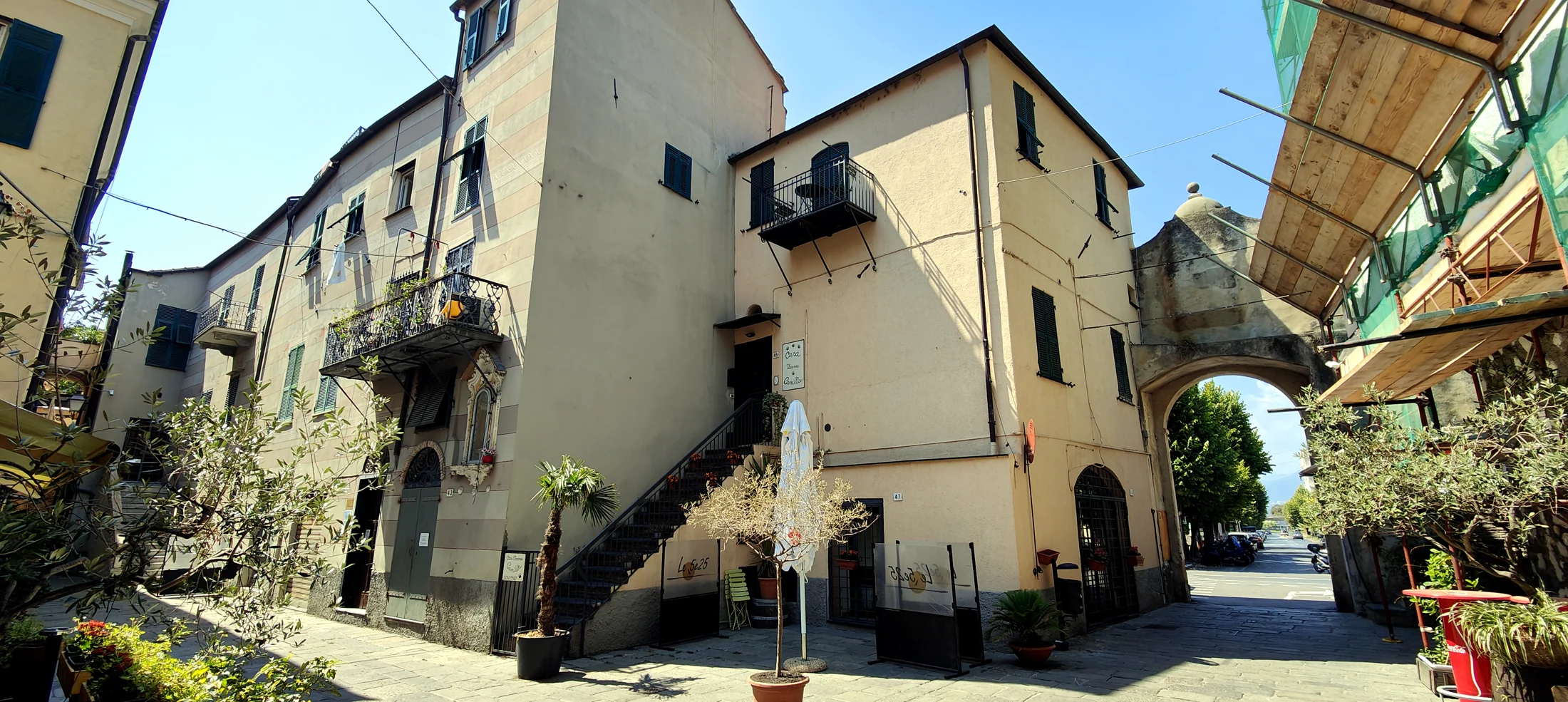
Most itineraries exist to solve distances. At Albenga distances are not a problem: station to baptistery, towers to museum, museum to beach are all walks of a few minutes, flat, inside the same radius.
The problem here is different: shade. An old town of narrow alleys between medieval towers is cool in the morning and the late afternoon, and a kilometre and a half of open beach is unbearable at noon and perfect at four. So Albenga's itinerary is not a route: it is a timetable.
This is what works.
Morning — 9 to 12: the old town
Start at the baptistery. Fifth-century, the oldest building still standing in all of Liguria, decagonal outside and octagonal inside, and it keeps a mosaic of Ravenna's era. Restored in the nineteenth century by Alfredo d'Andrade — the man behind much of how we read the middle ages in Piedmont and Liguria today.
Then the towers. In the thirteenth century Albenga had more than a hundred, and what makes them interesting is not their height: to build one you had to own at least one ship. They were not ornaments, they were balance sheets — the public declaration that a family traded by sea. Look at Albenga's towers knowing that and you are looking at a ranking, not a skyline. The most visible are the Torre Peloso Cepolla, the Torre Oddo and the Torre della Paciotta.
Three hours in the alleys is enough, and it is the best part of the day, because it is the only stretch the sun does not command.
Midday — 12 to 3: indoors, and not just for shelter
This is where most itineraries suggest a long lunch. At Albenga there is something better, fifty metres from the towers.
The Roman Naval Museum, inside the seventeenth-century Palazzo Peloso Cepolla, holds the cargo of a Roman transport ship that sank offshore between 100 and 90 BC. The amphorae come from the seabed you can see out of the window. This is not a collection assembled from elsewhere: it is what was inside one particular ship, in one particular year, in front of this town.
If there is time and appetite left, the multimedia centre of the Gallinara Island Reserve is a few steps from the station, with paid entry, and it gives a name to the island you will be looking at from the beach all afternoon.
Afternoon — 3 until evening: the beach
From the station to the free beaches it is 469 metres: seven minutes on foot, flat. No shuttle, no climb, no transfer.
The shore runs nearly a kilometre and a half, fine sand mixed with gravel, free and serviced stretches alternating — and Gallinara island is visible from all of them. At three in the afternoon the only choice left is where to settle, and there is room to make it.
The detail on free versus serviced is in beaches at Albenga.
If you have two days
The second day is not for adding monuments: it is for doing the same things at the right hour.
- The old town at sunset, when the towers take the low light and the alleys empty: a different town from the one at nine in the morning.
- A whole morning on the beach, which the single day never allows.
- And the plain inland: Albenga is an agricultural town, not only a seaside one, and you see it as soon as you step outside the perimeter.
The full picture is in Albenga: the complete guide.
What to skip
- Do not try to put the beach at noon. That is the mistake that ruins the day: an open shore with no natural shade, in August, at one o'clock.
- Do not drive within the town. The centre is a weave of alleys and the beaches are seven minutes from the station: the transport notes are in getting to Albenga.
- Do not rush the old town to get to the sea. The baptistery and the towers are why this town is worth a whole day rather than half a day of beach: the rest of the list is in what to see in Albenga.
With children the order is the same but the times shorten, and there is a way of telling the towers that works: it is in Albenga with children.
Frequently asked questions
Is one day enough for Albenga?
Yes, if the order is right: old town in the morning, museum or visitor centre at midday, beach from the afternoon into the evening. Everything is within a few minutes' walk, so the constraint is not distance but the sun.
What is the best order for seeing Albenga in a day?
Baptistery and towers between nine and noon, when the alleys are in shade; the Roman Naval Museum at midday, indoors; the beach from three onwards. The reverse — beach at noon, town in the afternoon — is the sequence that ruins the day.
What can you see at Albenga in one day?
The fifth-century baptistery, the oldest building still standing in Liguria; the medieval towers of the old town; the Roman Naval Museum with the cargo of a ship that sank between 100 and 90 BC; and nearly a kilometre and a half of sandy beach seven minutes from the station.
How long do you need for Albenga's old town?
About three hours for the baptistery, the towers and the alleys, unhurried. It is the part not to compress: it is why Albenga is worth a whole day.
Is it worth staying two days at Albenga?
The second day adds no monuments, it adds hours: the old town at sunset is a different town, and a whole morning on the beach is what a single day never allows.