 Soggiorna
In the 19th century Camogli was one of the great shipowning powers of the Mediterranean and was called "the town of a thousand white sailing ships". From that wealth made at sea there remain a museum, a theatre, a sanctuary full of votive paintings and the harbour where it all began. This guide follows the places in visiting order, from the sea up the mountain, with information from the Camogli tourist office.
The old island: basilica and Castel Dragone
The tip of the village was an island in the Middle Ages, and the town's political and religious life took place there.
- Basilica of Santa Maria Assunta. It dates from the 12th century and is reached from the harbour square up a broad flight of steps. The façade is plain; inside are three baroque naves, gilding, crystal chandeliers and coloured marble. Artists of the Genoese school such as Nicolò Barabino and Francesco Semino worked on the vault and side chapels; the high altar is by Andrea Casareggio. It is worth going in when the lights are on.
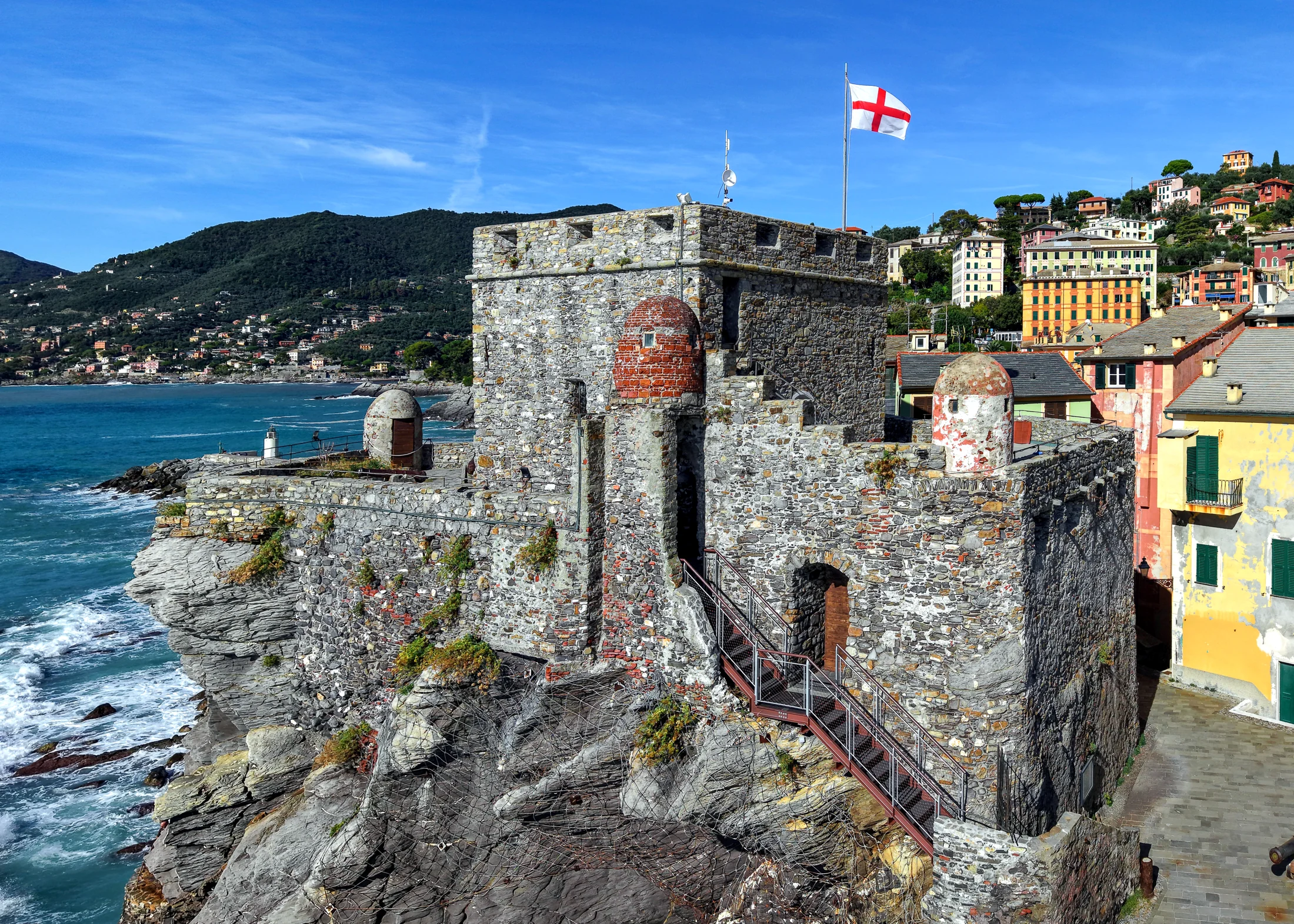
- Castel Dragone, also called Castello della Dragonara. Built in the 13th century on the rocks above the sea as a lookout against Barbary pirates, it has a forecourt with two 16th-century cannons. The popular name comes from "dragonaria", the whirlwind of a storm. Today it hosts exhibitions: you see the inside only when one is on, the sea terrace always.
The harbour and the seafront
The little harbour is the heart of the village: wooden gozzi, fishing boats, nets drying and the boats for Punta Chiappa and San Fruttuoso. From here the Via Garibaldi promenade begins, with its painted façades facing the beach. Look out for the village's wayside shrines: the "Madonna del Buon Viaggio", protector of fishermen and sailors, and nearby, in Via Tommaso Racca, the Madonna dei Gotti, named after the toasts raised in the old harbour taverns.
The Dragun
In the cold months the Dragun is on show in Largo Simonetti: the boat that symbolises Camogli's rowing tradition, made from an old lifeboat and decorated in memory of the pirate raids. It is 10.50 metres long, with two lateen-rigged masts and twelve four-metre oars, and has been a Unicef ambassador since 1978. In spring it goes back into the sea through the village streets.
The Gio Bono Ferrari maritime museum
Founded in 1937 by Gio Bono Ferrari, it is in the street named after him, near the old centre. It tells the story of Camogli's seafaring from the Napoleonic era (1797-1815) to the First World War: models of sailing ships and steamers, navigation instruments, prints and paintings, the original manuscripts of the statute of the Mutual Maritime Insurance founded in Camogli in 1853, Risorgimento objects and letters from Garibaldi and the Expedition of the Thousand. Opening hours change with the season: check the museum's website before you go.
Library and Archaeology Room
In the same Via Gio Bono Ferrari is the Niccolò Cuneo Civic Library, with over 56,500 volumes, which houses the Archaeology Room. On display are finds from the excavations carried out from 1969 at the Castellaro, a natural rock about 70 metres high above the sea: pottery fragments, loom weights, animal bones and burnt wood dated to the 12th-13th centuries BC, the first huts of the settlement. There are also Roman fragments from the 2nd-1st centuries BC. On summer hours, from 1 July, the library opens Tuesday to Saturday from 9 to 12.
The Teatro Sociale
It opened on 30 September 1876, built at the wish of sixty middle-class families who had grown rich from the sea. It was designed by the architect Salvatore Bruno: an Italian-style horseshoe theatre with four tiers of boxes and a gallery, over 400 seats, fully restored. You see it by going to a show: tickets are sold at the Pro Loco.
The Sanctuary of Nostra Signora del Boschetto
On the rise above the centre stands the sanctuary that Camogli's sailors chose as their own. Its collection of maritime votive paintings is one of the most consistent and data-rich records of 19th-century Camogli: ships in storms, shipwrecks survived, names of vessels and captains. At Christmas the Confraternity of the Addolorata sets up a nativity scene with 18th-century figures.
San Rocco
You climb from the centre up the mule track near the Carabinieri station, 900 steps and about half an hour, or take AMT bus 973. San Rocco is a small hamlet high above the sea, with a view reaching Capo Mele; in the church square stands the monument to the dog, erected in 1981 for the Dog Festival held here since 1962. The paths of the Portofino Park start from San Rocco.
Ruta and Portofino Vetta
Ruta is the hamlet on the Aurelia road between Recco and Rapallo, with the Chiesa Millenaria and the panoramic walk towards San Rocco. From here the only road climbs to Portofino Vetta, one of the busiest entrances to the Park. Ruta keeps the tradition of great processional crucifixes: the black "Mignanego" crucifix, carried for the feast of St John the Baptist, weighs 183 kilograms and is remembered as the heaviest in Liguria. At Christmas the oratory hosts a living nativity with animals.
Punta Chiappa and San Fruttuoso
Punta Chiappa is an old fishing hamlet on a tongue of rock in the Marine Protected Area, with a Fishing Museum: you reach it by boat in 15 minutes or on foot from San Rocco in about an hour. Swimming off those rocks is described in our guide to the beaches of Camogli.
San Fruttuoso, with its Benedictine abbey and the Doria tower, is also in the Municipality of Camogli: it has its own guide, San Fruttuoso, and a day itinerary.
Planning your visit
- Half a day: harbour, basilica, Castel Dragone, seafront and maritime museum.
- One day: add the climb to San Rocco and the descent to Punta Chiappa, coming back by boat.
- Two days: keep the second day for San Fruttuoso, by boat or on foot.
Boat times and fares are in the Camogli guide; trains and parking in How to get to Camogli and where to park.
Frequently asked questions
What is the most important monument in Camogli?
The Basilica of Santa Maria Assunta, from the 12th century, on the old island beside Castel Dragone. It is the symbol of the village.
Can you visit Castel Dragone?
The 13th-century castle hosts exhibitions: you see the inside when one is on, while the terrace with the two 16th-century cannons is always open.
What is in the Camogli maritime museum?
Models of sailing ships, nautical instruments, paintings, the 1853 statute of the Mutual Maritime Insurance and letters from Garibaldi: Camogli's seafaring history from 1797 to the First World War.
How do you get to San Rocco?
On foot up the 900-step mule track, in about half an hour, or with AMT bus 973 from the station.
What is the Dragun?
Camogli's emblematic boat, 10.50 metres long, with twelve oars and two lateen-rigged masts. In winter it is on show in Largo Simonetti.