 Soggiorna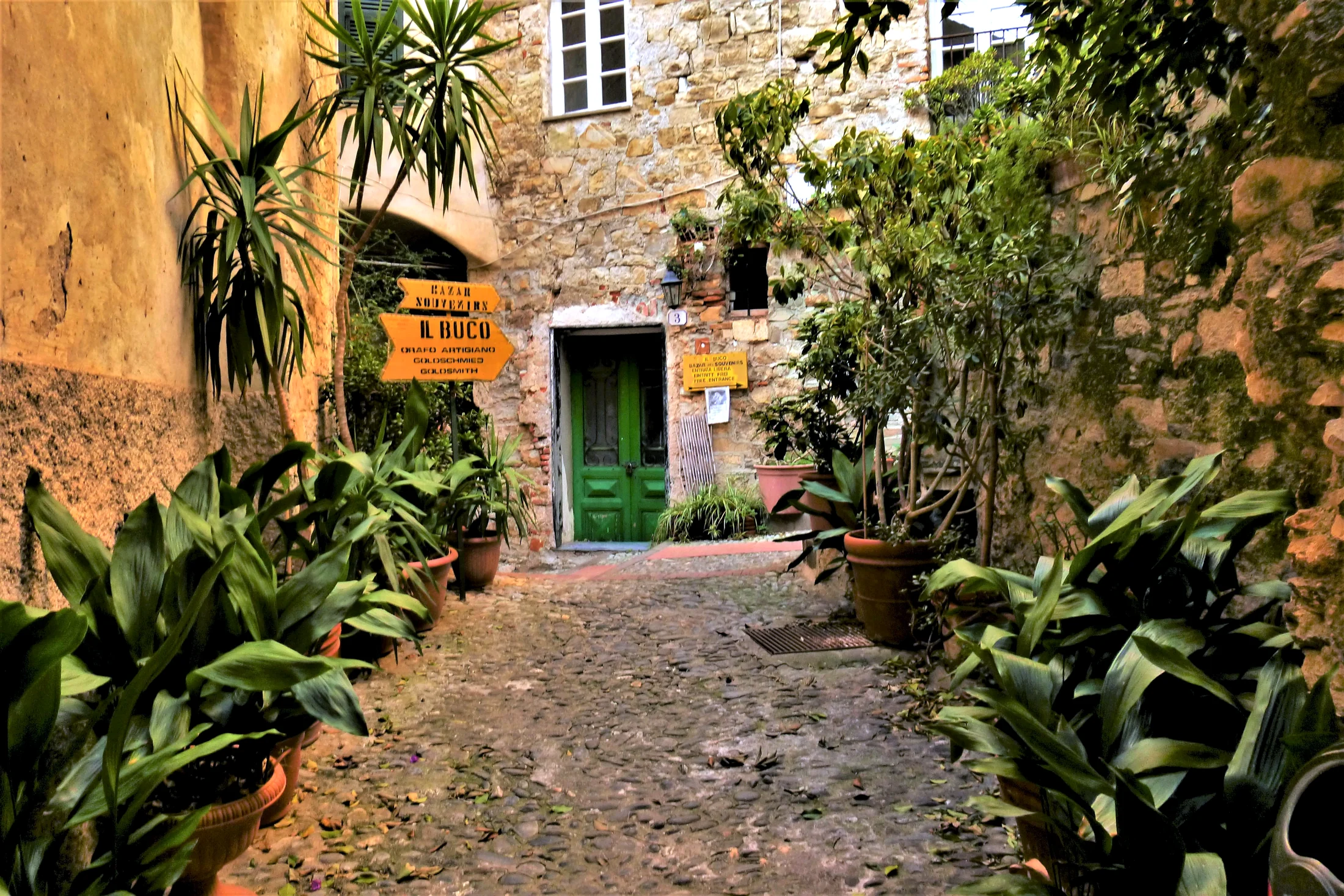
Cervo is a visit of a few hours, and that is not a limitation: it is its measure. The village has 470 inhabitants, stands 67 metres above the sea and is crossed on foot, climbing up one side and coming down the other. There are four things to see, and they are all along that climb.
What decides whether the visit is worth it is when you go, not how long you stay.
The Corallini church
It is the parish church of San Giovanni Battista, and the nickname says where the money that built it came from: the proceeds of the companies that practised coral fishing in the waters of Sardinia and Corsica. Work began in 1686 and finished in 1734.
The façade is one of the finest examples of Ligurian baroque and justifies the climb on its own. But what stays with you is where it stands: the church dominates the village's outline and is visible from the coast road long before you arrive, and when you get there you find it at the top of the lanes as though the village had been built to carry you to it.
The forecourt, which is the real monument
The open space in front of the church works as a balcony over the sea. It is where everyone who climbs up stops, and it is the reason to be in Cervo at sunset rather than at midday.
And there is a second, less obvious reason: the acoustics. It is because of them that every July and August, for more than forty years, the forecourt has hosted the International Chamber Music Festival, which gave Cervo the title of village of music. If you come in summer, look at the programme before choosing your dates: hearing chamber music on that terrace, with the sea below, is the best thing this place does.
The Clavesana castle
In the upper part stands the castle, built in the twelfth century by the marquis of Clavesana, with three round towers. It began as a private residence; in the seventeenth century it was divided in two and the lower section housed a hospital.
Today it holds a museum and the tourist office, on piazza Santa Caterina. It is the sensible first stop on arrival, not the last: from there you understand how the village is laid out, and you can ask what is open that day — information that in Cervo, out of season, changes more often than you would expect.
The lanes
There is no itinerary and none is needed: the old centre is a weave of alleys, arches, staircases and small squares, and the right way to visit is to go in and wander, alternating walking with stopping where the view opens up.
Two practical warnings, both true:
- You need the right shoes. Stone, slope and steps, everywhere. In summer the hour matters too: the climb at midday in August is avoidable effort.
- It is not a place for anyone who struggles walking uphill. There is no flat alternative route, and that should be said before rather than after.
The name, which tells you something
The village was originally called by the Latin name Servo, changed to Cervo in the sixteenth century. It is a one-line detail, but it says this place has a history longer than its recent fame as a photographed village.
Cervo holds full membership of the Most Beautiful Villages in Italy, and that is the kind of recognition that usually brings coaches: the way to miss them is to go early in the morning or in the evening.
And the olive oil
The local product is extra virgin olive oil, and that is not a food note added to fill space: the olive groves are what you see from every viewpoint in the village, and the paths behind it run through them. Here the landscape and the product are the same thing.
How to put the visit together
- Two hours: castle, lanes, forecourt. That is Cervo.
- Half a day: add the walk down to the sea and along the front.
- A summer evening: the concert on the forecourt, which is the best reason to be there.
Before you walk up to the village
Cars cannot drive through the lanes, but you do not have to leave the car down below: you can drive up to the castle square and park on the free unpaved area, or a little further on where parking is paid — and it is not paid all year, so it is worth reading the signs. In July and August, and on festival evenings, come early: there are few spaces. By train you get off at Diano, about four kilometres away, and continue by bus or taxi, because Cervo has no station of its own. The stairways make the village hard going with pushchairs or wheelchairs; the seafront, on the other hand, is flat.
Frequently asked questions
What can you see in Cervo in a few hours?
The Clavesana castle with its museum, the lanes of the old centre and the Corallini church with its forecourt looking out over the sea. Those are the village's four things and they all lie along the same climb.
Why is the church at Cervo called dei Corallini?
Because it was built with the proceeds of the companies that practised coral fishing in the waters of Sardinia and Corsica. Construction ran from 1686 to 1734 and the façade is one of the finest examples of Ligurian baroque.
How old is the castle at Cervo?
It dates from the twelfth century and is the work of the marquis of Clavesana. It has three round towers, it was a private residence, and in the seventeenth century it was divided in two: the lower part housed a hospital. Today it holds a museum and the tourist office.
When is the music festival at Cervo?
In July and August, on the forecourt of the Corallini church. It has run for more than forty years thanks to the acoustics of the square, and it gave the village its title of village of music.
Is Cervo tiring to visit?
The village is all alleys, steps and slopes, with no flat alternative routes. For anyone who walks well it is a short stroll; for anyone who struggles uphill it is a real difficulty, and worth knowing before booking.